By Dr. James McAdams
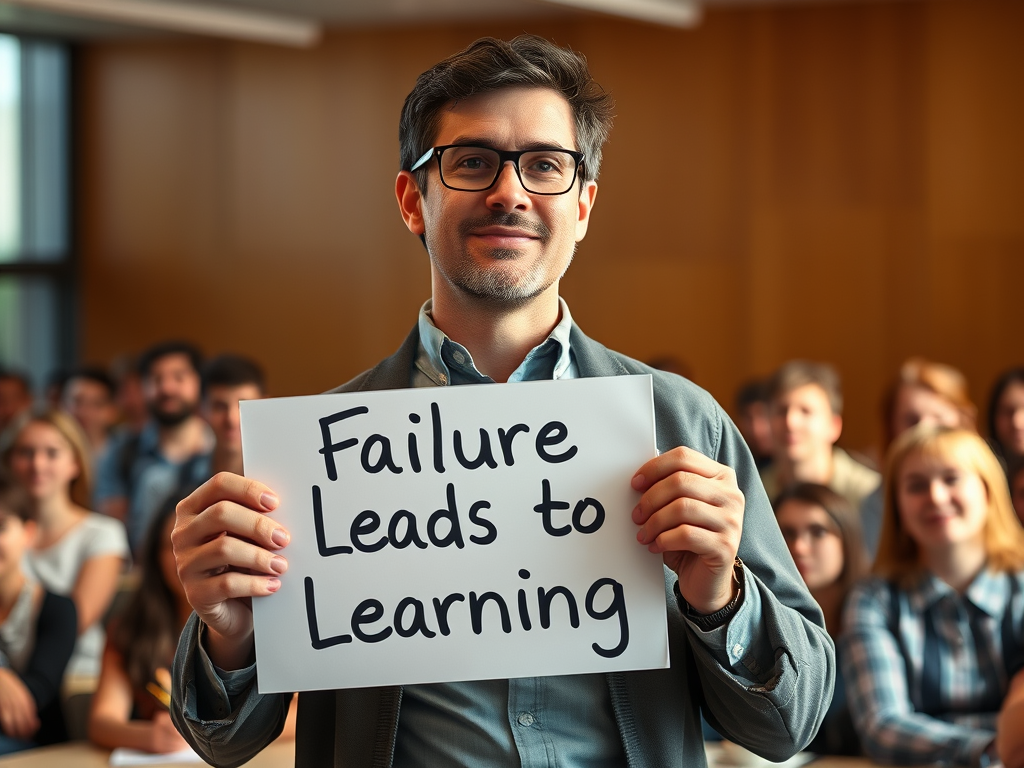
In popular culture, professors are often acclaimed as experts and lauded for their academic success. At the same time, like everyone else, behind the diplomas and peer-reviewed articles and awards, there are stories of failure, error, and disappointment. Sharing these stories with students not only makes the classroom more even and democratic, but teaches students to not become psychologically attached to their failures, and to feel empowered to share areas of their expertise, in the process becoming professors themselves.
When I began teaching twelve years ago, I used the Samuel Beckett quote “Ever tried. Ever failed. No matter. Try again. Fail again. Fail better[.]” as an epigram to my creative writing course syllabi (1989, p. 101). (How easy it is for Nobel Prize winners to joke about “failing.”) Now I think it should be included in all syllabi, church sermons, public health announcements, sports events, reality TV shows–essentially any area of human activity. Ironically, I feel as though I’m failing at writing this blog right now because I can’t find two peer-reviewed articles since 2020 to support my thesis, which is that by self-disclosing our past failures and admitting to current areas of ignorance, professors raise student confidence levels and empower students to share their own domains of knowledge expertise.
For example, just this term, I have admitted (honestly, not as a pedagogical strategy; I really am this feckless) to not knowing what hot/cold setting to use when doing laundry, not knowing how to change my car’s oil, and, causing eruptions of laughter and life-advice, that I’d never had sushi. In each case, students popped on their cams and mics and gave advice about how to change oil, how to optimize the thermal dynamics of laundry, and discussed their own favorite foods. This isn’t normally what we denote by a “flipped classroom,” but in cases such as these, by making ourselves vulnerable and objects of ridicule (essentially my daily experience anyway) we can remind or inform students that they, too, have the skills and institutional authority to be professors in cooking classes, laundry classes, vo-tech schools, and so forth.
I normally introduce myself to my Composition 1 and Composition 2 students with the following oration (without as many details, and obviously not verbatim):
“Hi, I’m James, and I am a failure. When I first went to college at the age of 27, I was an unemployed high-school dropout squatting at friends’ apartments located two blocks from Lancaster, Pennsylvania’s Regional Hospital, where I’d been born 27 years before. I often remarked then how this symbolized what a waste my life was, resulting in my friends’ designating me with the appellation ‘Killjoy.’ During this period, I slept on a couch in unfurnished rooms all day and drank every night, looking for coins under couch cushions to buy cigarettes. I had neither girlfriends nor job prospects, because, again, I had never graduated from high school, and had my license suspended for a DUI whose specifics are too embarrassing and unprofessional to reveal here. As a part of the DUI process, I was assigned a lovely probation officer named Rosie Perez, like the actress, who encouraged me to obtain my GED” (I’ve also told a different version of this story before in McAdams, 2015).
Then I stop and point to the five degrees on my wall behind me, and say, “Of all these, the one I’m most proud of is the unframed, off-centered GED with water stains.”
Apparently, I’m not alone. This year, Ohio State University hosted a conference focused entirely on the psychology of academic failure. Lead organizer Patrick Louchouarn, Ohio State’s Senior Vice Provost for Faculty, explained “there is something liberating and holistic in bringing the stories of failures into our narratives of success” (as cited in Gasman, 2024, para. 9). His inspiration was Harvard Professor Amy Edmondson’s book The Right Kind of Wrong: The Science of Failing Well (2023). In an excerpt from this text, Professor Edmondson related her feeling of horror when, as a graduate student collating survey results for a professor’s conference paper, she realized she had entered the wrong data. After a deep breath, however, she began to think about the long-term effects on her research. As she elaborated, “To err is human. Mistakes happen—the only real question is whether we catch, admit, and correct them. Maybe the good teams, I suddenly thought, don’t make more mistakes, maybe they report more” (Edmondson, 2023, pp. 18-19). Instead of viewing error as incompetence, she explained, she re-interpreted it as inherent in any academic inquiry, as failure is an irreconcilable part of any human endeavor. For this reason, I bravely risk my job in advocating a “pedagogy of failure” (Eckstein et al., 2023, p. 11).
In a more humorous tone, Princeton Psychology Professor Johannes Haushofer published his “CV of failures” (which is a thing now) to great acclaim. “Most of what I try fails,” he admitted, “but failures are often invisible, and successes are visible” (Haushofer, 2017, as cited in Hrala, 2017). He then proceeded to list all the academic programs he was rejected from, which you should definitely check out.
Emphasizing your academic failures as a pedagogical strategy to improve student success may seem as paradoxical as George Costanza’s “The Opposite!” philosophy (David et al., 1994), but I have since integrated it into my teaching philosophy and seminar schedule (rather, writing this blog has inspired me to start doing that). As Erickson et al. (2024) observed, “students find a professor relatable because [failures] are common struggles” (para. 6). It can be seen as opening a discursive field and creating a community. According to Kenneth Austin (2016) of Austin (not a typo!) State University, “an empowering teacher educator prioritizes dialogue and conversation over hierarchical instruction, believing that authority is best dispersed over many voices, rather than located in a single individual’s mentoring or regulatory position” (p. 58). What methods can we use in seminar, or discussion boards, or in assignment feedback, to adjust the professor-student dynamic, which is sadly viewed as Platonically hierarchical, Us/Them, Right/Wrong?
Earlier this year, after ordering three pairs of glasses, I started the seminar by asking the students which pair looked best on me, yielding perhaps the most student engagement, probably ever, and a Zoom poll that, once again, I failed to operate properly. In another seminar, I recall listening to another student who was lamenting that their child had just been diagnosed with autism spectrum disorder (ASD), and another student, who had never engaged before, opened her camera with great passion and referred to her work in applied behavior analysis (ABA) therapy while giving the parent tips. Currently, one of my Composition 1 students is writing a paper on environmental, social, and governance (ESG) investing (United States Securities & Exchange Commission, n.d.). After reading his Unit 6 journal, I joked that the class needed him as a financial advisor. He had never attended a seminar before, but to my delight, he opened the seminar on camera and taught the entire class the benefits of this strategy with clear relish.
Obviously, this behavior is easier for some professors than others. Vulnerability and all that. Perhaps we could start discussion boards along the lines of “Life Tips” or “Life Hacks,” where students could ask questions about taxes, or cars, or technology, and other students could answer. You don’t necessarily have to embrace failure to the extent I do, but please do look for incidents in your life when you can ask the class questions that make them the professor and you the student.
If it doesn’t work the first time (what does?), do it again: fail better. I’ll fail better next time, too.
References
Austin, K. (2016). Personal transformative pedagogy and recovery from failure: The reconditioning of a university professor. International Journal of Pedagogy and Curriculum, 23(4), 57-64. 10.18848/2327-7963/cgp/v23i04/57-64
Beckett, S. (1989). Worstward ho. In Nohow on, pp. 101-128. John Calder. (Original work published 1983)
David, L., Seinfeld, J., & Cowan, A. (Writers), & Cherones, T. (Director). (1994, May 19). The opposite (Season 5, Episode 22) [TV series episode]. In L. David & J. Seinfeld (Executive Producers), Seinfeld. Castle Rock Entertainment.
Eckstein, L.E., Finaret, A.B., and Whitenack, L.B. (2023). Teaching the inevitable: Embracing a pedagogy of failure. Teaching and Learning Inquiry, 11, 1-19. https://doi.org/10.20343/teachlearninqu.11.16
Edmonson, A. (2023). The right kind of wrong: The science of failing well. Simon and Schuster.
Erickson, C. A., Hernandez, J. O., Hoekstra, S. J., Jordan, A. C., & Hill, K. G. (2024). Self-disclosures during lecture affect students’ perceptions of professor but not student learning outcomes. Teaching of Psychology. https://doi.org/10.1177/00986283241295372
Gasman, M. (2024, May 13). Failure and the pursuit of joy in academia. Forbes. https://www.forbes.com/sites/marybethgasman/2024/05/13/failure-and-the-pursuit-of-joy-in-academia/
Hrala, J. (2017, December 25). This Princeton professor’s CV of failures is something we should all learn from. Science Alert. https://www.sciencealert.com/why-creating-a-cv-of-failures-is-good-Princeton-professor-viral
McAdams, J. (2015). My back pages. r.kv.r.y. quarterly literary journal, xii(3). https://rkvryquarterly.com/my-back-pages-by-james-mcadams/
United States Securities and Exchange Commission. (n.d.). Environmental, social, and governance (ESG) investing. https://www.investor.gov/introduction-investing/investing-basics/glossary/environmental-social-and-governance-esg-investing


 The WACademic
Leave a reply to Anonymous Cancel reply