Implementing the Liquid Syllabus in Competency-Based Composition Courses

By Gabriel Smith
In competency-based, asynchronous writing courses, building community can feel like an uphill battle—especially when students face anxiety around the writing process. This post explores how implementing a liquid syllabus offered a simple, personal touchpoint that helped students feel more connected and confident. Early results show that humanizing the course not only eased uncertainty but also improved mastery pass rates in composition assignments.
Introduction
I’ve always believed that writing happens best when students feel part of a community. In our seminars at Purdue Global, that sense of connection comes naturally—through live discussions, shared challenges, and the casual conversations that remind students they’re not alone in the writing process.
But when I shifted to teaching the CM220 Modules, a competency-based, asynchronous version of College Composition II, that familiar sense of community was missing. No seminars or peer interactions were required, only optional live sessions and ungraded discussion threads. Essentially, just students, a list of assignments, and—too often—a quiet sense of uncertainty. Especially for students already anxious about writing, the absence of connection can make a challenging task feel even harder. That’s when I decided to try something different: bringing a more personal, human touch to the course through a liquid syllabus.
Developed by Michelle Pecansky-Brock (2021), a liquid syllabus is a public-facing website that faculty can use to bring a personal element into the online classroom. It is typically shared before the start of the term and offers an introductory video, a casual walk-through of the course syllabus, sample assignments, and other supplemental information to support student success.
I was introduced to the liquid syllabus in the Association of College and University Educators (ACUE) online teaching program last year, and I instantly saw an exciting application for it in the CM220 Modules. This competency-based version of our research writing course at Purdue Global asks students to explore a community or workplace problem and develop a persuasive research essay that we call the “idea for change.” Focusing on a specific problem in their own community or workplace gives students a path toward implementation, which helps to bridge the gap between the writing classroom and their “real lives.”
Over the years, I’ve had many students use their research projects to make actual, tangible changes in their communities, and that reinforces the real-world application of our course content. Writing can be a powerful tool for change, an important lesson for composition students across all levels of skill and experience.
Launching the Supplemental Syllabus Pilot
Because community itself is such a significant part of what we do in CM220, I decided to build my own liquid syllabus to share with one section of students. To mitigate student confusion, I referred to this site as my “supplemental syllabus” content rather than as a “liquid syllabus.”
In December 2024, I piloted the full supplemental syllabus in one of three sections of CM220:
- Section 1: Students received a link to the full liquid syllabus through the classroom announcements.
- Section 2: Students received the supplemental video content but not the entire supplemental syllabus site.
- Section 3: Students received standard written announcements without any additional supplemental material.
The goal was simple: to offer students a more personal and welcoming experience before the term began — an approach supported by Pecansky-Brock, who notes the importance of “mitigating belonging uncertainty” during the week prior to class start (2021, para. 3). Offering students a sneak peek of the course, the assignments, and encouraging that sense of belonging – I suspected – would also help to improve pass rates or at least limit the number of attempts that students would need to make before attaining proficiency. Given that CM220 Module students can enroll throughout the term and work at their own pace, the liquid syllabus provides a consistent and welcoming touchpoint for the course and for each specific module.
The liquid syllabus I created includes:
- A short welcome video introducing myself and the course.
- A course overview highlighting expectations and goals.
- A series of video overviews for each competency assessment (CA), designed to bolster student confidence and ease uncertainty regarding module expectations.
I also wanted to know how students felt about the additional resources and if that content aided in their CA submissions, so I programmed an intelligent agent in the classroom to assist with simple data collection. When students completed and passed an assessment, they were automatically sent a congratulatory message with a link to a Google survey with the following questions:
- What did you find helpful about the supplemental syllabus?
- What other information / resources would be helpful to include on this Google Site?
- On a scale of 1 to 10, how helpful was the supplemental syllabus information as you developed your CA submission?
- Do you have other suggestions for improving this Google Site?
The Data: Measuring Impact
Figure 1
Overall Summary Across All Modules
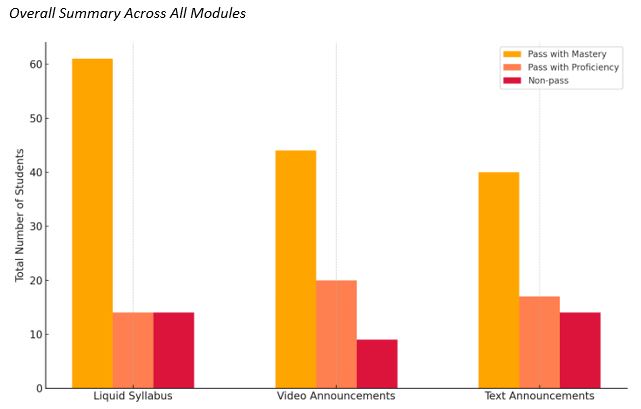
Note. This figure demonstrates total number of students and pass rates for each section of the pilot.
At the end of the term, I was eager to see if/how the liquid syllabus influenced student pass rates, so I compiled submission data from each Module. As noted in the key from Figure 1, students can either pass with mastery, proficiency, or not pass the assessment. Students can offer as many revisions as necessary before they reach proficiency, so non-passing grades are typically the result of students timing out. This point is confirmed by assessing non-passing scores in correlation to date of submission. For instance, Module 2 data from Section 1 (the Liquid Syllabus section) indicates that 80% of non-passing CAs were submitted within the final weeks of the term which did not give students enough time to successfully implement necessary revisions.
Figure 2
Pass Rates Across All Modules and Sections
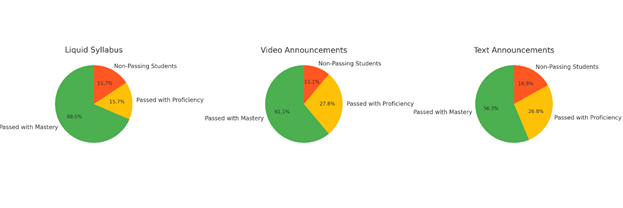
Note. This figure highlights mastery and pass rates across all three sections of the pilot.
Across all three sections and modules of the course, students with access to the liquid syllabus had higher rates of passing with mastery than either of the other sections in the pilot. Whether the inclusion of the supplemental syllabus content helped to build a greater sense of community is difficult to assess, but survey results do indicate that students both reviewed the supplemental content and used it as they developed their CA submissions. Survey results were overwhelmingly positive:
- Average helpfulness rating: 9.75/10
- Students praised the introductory video for increasing their confidence.
- Several commented that the videos provided clear guidance that made the CAs feel less overwhelming.
Of the 17 survey responses collected from students who had access to the liquid syllabus, one commented on my introductory video that “it gives me confidence [about] the person who will be giving me feedback.” Another student found the examples “very helpful and the explanations […] clear” following up with “writing has always been a struggle for me, but this helps!” Any tool that can ease anxiety and effectively help students move into the writing process is worth exploring further, and that’s where I find myself now as I revise, tweak, and polish my supplemental syllabus for the upcoming term start.
Conclusion: A Promising Start
The student feedback and improved mastery pass rates from this pilot have been both encouraging and enlightening. In a learning environment where students often work independently and face heightened anxiety around writing tasks, small efforts to humanize the course can make a meaningful difference.
These early results have prompted me to expand the use of the supplemental syllabus site to all of my CM220 Module students in future terms. Building community might look different in a competency-based classroom — but tools like the liquid syllabus prove that it’s possible to make students feel seen, supported, and connected. In doing so, we don’t just improve pass rates — we help students engage more fully with the writing process, reduce apprehension, and remind them they’re not navigating it alone.
Reference
Pacansky-Brock, M. (2021). Liquid syllabus.





 The WACademic
Leave a reply to Leslie Johnson Cancel reply