

By Lisa Teiter
Higher education has not always been known as a place of kindness, but it is possible to change that. Employing a Pedagogy of Kindness creates situations from which all involved benefit. Using intentional, calming, and kind strategies can improve students’ overall experience and create a more rewarding, nurturing experience for instructors.
Shine your Kindness

In 1994, The Allman Brothers Band recorded the album Where It All Begins, with Gregg Allman singing the lyrics to “Soulshine” written by Warren Haynes. A few years later, I drove from Tallahassee to Dallas playing “Soulshine” on repeat, unaware that the song would become part of who I am as an educator. When Haynes thought of the song lyrics and music, he did not have a pencil and paper with him and described how he “just kept singing it over and over, until I could find my way home so I could put it down because I didn’t want to forget it” (“Long Live,” 2023). That on its own is worthy of sharing, but he continued the songwriting experience, explaining that he “kept trying to figure out some way of making it more complicated or more complex or something. And thinking that it was just too simplistic. But the more that I tried to do that, the more it just kind of seemed to mess it up, so I wound up just going, well, I guess it’s just meant to be this simple little […] song” (“Long Live,” 2023). This “simple little” song describes how some days are complicated, challenging, and hard, with an inspiring, heartfelt chorus of “You gotta let your soul shine, shine till the break of day” (Haynes, 1993).
Making the connection between the song and teaching College Composition I may be quite a leap, but it’s really not. Haynes looked for ways to make the song more complicated and more complex but arrived at the truth that the simplistic approach may be the most beautiful one. We can teach with simplicity. We can teach with kindness. We can teach with calm.

About a year ago, my daughter started teaching private dance classes. Her technique and style are strong, but she has not had the life experience to develop or learn how she wants to teach. When we brainstormed ways that she could instruct, she asked me how I teach writing. Trying to find a way to describe my pedagogical approach to my 15-year-old, I explained that my guidance and instruction move from my brain to my heart to my delivery. That every interaction, if I am capable of it, travels through my heart, and I try to be kind, caring, intentional, patient, and compassionate. Talking about heart or soul shine is not a very academic topic; as Cate Denial, author of The Pedagogy of Kindness, acknowledges, “academia is not, by and large, a kind place” (2019, para. 1). But without kindness at “its core, higher education fails students and instructors–and its mission–in critical ways” (Denial, 2019, para. 1). A kind, compassionate, gentle, caring classroom can improve success and student wellness (Rawle, 2021).

Here are some practical, simple ways I approach the classroom with kindness, heart, and a shiny soul:
- We progress instead of perfect. There is an intentional shift away from practice makes perfect to practice makes progress. If we can move students away from the need to be perfect and emphasize progress, there is space to help them cultivate healthy and effective habits. Progress also invites kind internal thoughts.
- We move slowly and gently. We slow seminars down. We slow the writing process down. I used to feel rushed to complete all of the slides or cram all of the unit’s content into the Seminar, only to find I lost my voice and felt stressed. That was not a kind approach for the students or for me. Now I take things slowly. We linger and luxuriate in the lesson until we are ready to move forward. We try to find our calm in the learning.
- We play. We play with thesis statements, we play with Point, Illustrate, and Explain (PIE), we play with American Psychological Association (APA) citations, and we play with Chat GPT. Calling it “play” removes some of the pressure and infuses the learning with a nod toward progress. Play invites mistakes and practice. It’s a safe space to try and mess up and try again.
- We breathe. There are always a few units that are a bit more stressful than others, and when those happen, we take a couple of minutes to breathe. With one hand on the belly and one hand on the heart, we tap into slowing down and taking cleansing deep belly breaths to help calm the central nervous system and regulate emotions.
- We pebble. Male penguins bring their special female penguin a beautiful pebble to show their love. It’s a penguin act of love and kindness. In CM107, I pebble. For example, I pebbled this Instagram post in Seminar during Unit 8 when students were feeling a bit stressed:
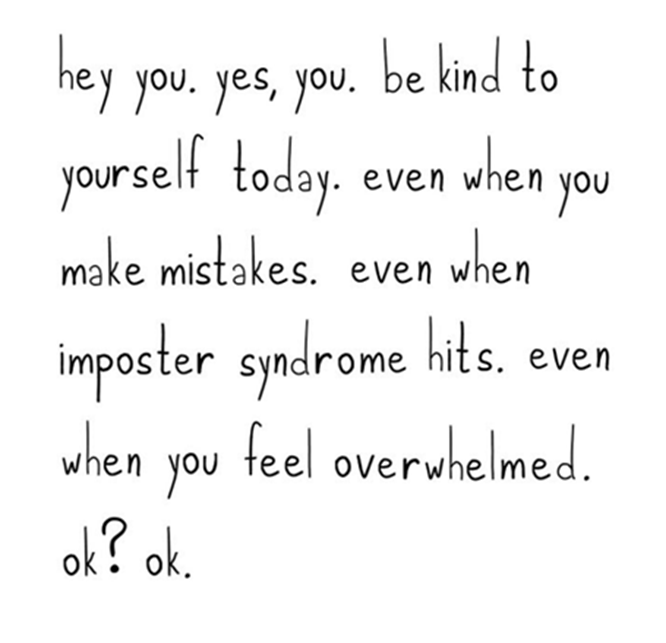
6. We hold space. Palmer (2016) wrote,
Here’s the deal. The human soul doesn’t want to be advised or fixed or saved. It simply wants to be witnessed — to be seen, heard and companioned exactly as it is. When we make that kind of deep bow to the soul of a suffering person, our respect reinforces the soul’s healing resources, the only resources that can help the sufferer make it through.
We can’t fix our students’ problems or make their stress disappear, but we can hold space for them. Epstein (2023) explained that holding space includes being present, creating a safe space, showing empathy, and listening.
The Pedagogy of Kindness is not just how we treat or interact with our students but also invites us to be kind to ourselves. So, I want to gently remind you to let your soul shine. Welcome progress and quiet the perfectionist, mean voice in your mind. Slow down. And then slow down some more. Invite calm into your day. Play when you can, especially if you are learning something new. Breathe intentional, cleansing, and calming breaths, with one hand on your heart and the other on your belly. Be kind and loving in your online communication. And hold space for yourself.
Go ahead. Find your way home. Let your soul shine.
References
Clark, M.C. [@michellcclark]. (2024, September 24). Hey you. Yes you. [Instagram photo]. Instagram.https://www.instagram.com/p/DATYUUKO6ph/?utm_source=ig_web_copy_link&igsh=MzRlODBiNWFlZA==
Denial, C. (2019). A pedagogy of kindness. Cate Denial. https://catherinedenial.org/a-pedagogy-of-kindness/
Epstein, S. (2023, May 25). What does it mean to hold space? Psychology Today. https://www.psychologytoday.com/us/blog/between-the-generations/202305/what-does-it-mean-to-hold-space/
Haynes, W. (1993). Soulshine [Song recorded by The Allman Brothers Band]. On Where It All Begins, 1994.
Long Live the [sic] Allman Brothers Band. (2023, December 9). Warren Haynes on writing Soulshine. [Facebook page]. Facebook. https://www.facebook.com/photo.php?fbid=331580229664498&id=100084375692859&set=a.100939439395246
Palmer, P. J. (2016, April 27). The gift of presence, the perils of advice. On Being. https://onbeing.org/
Rawle, F. (2021, August 20). A pedagogy of kindness: the cornerstone for student learning and wellness. The Times Higher Education. https://www.timeshighereducation.com/campus/pedagogy-kindness-cornerstone-student-learning-and-wellness


 The WACademic
Leave a reply to Lonelle Rathje Cancel reply