

Diverse Design to Dispel Disengagement
By Dr. Ritu Sharma
This blog shares a personal journey from the less engaging, rote-learning educational system in India to the dynamic, inclusive pedagogical approaches in the USA. It contrasts the lack of personalized attention and discouraged creativity with current methods that emphasize engagement, diversity, and individualized learning styles. The text highlights how these modern strategies, including technology integration and varied assessments, empower students and foster a sense of belonging and success.
Growing up in India, my school experience was so different. I can still feel the stifling air of those relentless afternoons in our jam-packed classroom—sixty-plus students crammed into rows, enduring the educator’s droning monologue, now and then refreshingly broken by a buzzing fly or the attendant bringing a glass of water for the tired teacher. I was left wondering who was more disinterested, the teacher who barely established eye contact or the students who hardly understood a word? Who was the first one to give up? Or was it a mutual feeling?
Although India can be considered the world’s most extensive education system, serving over 250 million students, the facilities were inadequate. The blackboard was our only visual lifeline, cluttered with dense equations scribbled in haste, expected to be memorized. Curious but nervous, I once raised my hand to suggest an alternative method. The response was swift and curt: “Follow the textbook. No deviations!” That moment etched itself into my mind, not just for the dismissal, but for what it revealed about the class facilitation and content delivery.
Every day unfolded the same: rows of silent and obedient students copying notes with somewhat mechanical precision to win the rat race. Dialogue was discouraged; creativity unwelcome. Critical thinking and practical skills were low. Also, there was a sharp disconnect from the real-world applications. This British-designed education was established to create followers and not leaders. It was knowledge-heavy and skill-light. And on top of it, there was a blatant devaluation of rich traditional knowledge.
I remember Arjun, who could fix anything he touched and grasped physics through mere intuition. Yet he struggled in written exams because they demanded rote regurgitation, instead of understanding the concept. This was a prime case of intellect defeated and curiosity shunned. Priya, from a village, saw the world in vivid mental images, but because her way of learning didn’t fit the mold, she was unfairly branded as “slow” and often made fun of. No one wanted to sit near her, and she became a pariah. She would often be punished for being disinterested and resting her head on the desk. She withdrew and stayed in her little cocoon. Even physical exercise, yoga, recess, or arts class could not excite her. Soon, she changed schools and was quickly forgotten. Who knows if she dropped out? We lost track of her and moved forward in a cut-throat competitive scenario where we would be ranked low for earning 0.1% less than other classmates. We became deeply entangled in what resembled the principle of survival of the fittest.
Figure 1
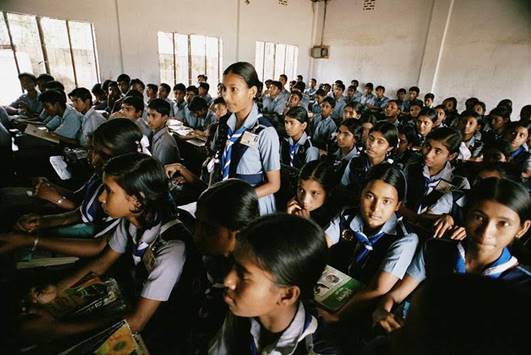
Note. Girl stands to respond to teacher’s question in crowded Mauchak Scout High School, Gazipur. 2007. Photo: Scott Wallace / World Bank. Flickr (https://www.flickr.com/photos/worldbank/1117179608). CC BY-NC-ND 2.0.
In a land celebrated for its diversity—languages, religions, cultures, perspectives—we sat in a homogenized space, stripped of individuality. Our classroom resembled more an assembly line than a place of discovery, requiring memorized answers and suffocating sparks of originality. The system valued only one kind of intellect, overlooking the brilliance that did not conform. In trying to earn an A, we lost sight of the journey, and those whose talents and contributions did not fit into little boxes were silenced. This contradiction was concerning and taught me what not to do in the classroom. In the coming years, I worked hard to cater to students’ individual learning styles and to enhance their engagement and success in my classes. After thirty years of teaching in the US, India is a distant memory.
Here in the USA, composition courses are fundamentally social. They are processes of communication, exploration, and collaboration. An online composition class, however, can easily become a solitary experience. As educators, we actively cultivate engagement and humanize teaching to foster effective learning and equip students with robust writing and critical thinking skills. We not only teach but also advise and guide them. We become their cheerleaders and are sometimes the only spark in the dark. This sense of connectedness and belonging proves to be at the core of teaching. Research by Dulfer et al. (2025) indicates the dialogic nature of webinars, field trips, and discussion boards, and how such collaborative approaches promote a sense of belonging in a learning community where the students contribute to the collective learning by engaging and supporting their peers through their academic journey.
As dynamic educators, we build bridges by incorporating inclusive teaching methods where students from various backgrounds, cultures, and life experiences can learn, grow, and succeed. Online courses have an influx of diversity due to international students representing multiple ethnicities and cultural backgrounds alongside first-generation college students, underrepresented minorities, military, professionals with different academic strengths and perspectives. Joosten and Cusatis (2020) identify that minority students have a higher preference for socialization. A welcoming, engaging, and interactive environment highlights teaching rooted in culturally responsive pedagogy, andragogy, and heutagogy with multiple assessment methods, including low-stakes activities like journaling, scaffolding writing processes requiring group discussions, thesis statements, research plans, or persuasive maps before drafting an essay. Instructors provide targeted feedback at each step.
Our assignments involve podcasts, videos, or digital presentations, allowing students to explore different forms of expression. This is followed by clear and detailed rubrics to articulate expectations and provide a roadmap for success. We demonstrate a strong presence by not just grading, but actively participating, posing follow-up questions, synthesizing discussions, and acknowledging student contributions. There is consistent communication via announcements and emails regarding upcoming assignments, learning objectives, helpful resources, and reminders. Furthermore, virtual office hours and optional seminars address individual student needs and ensure equity. What a vast and welcoming contrast compared to my learning experience!
This education system embraces multicultural perspectives, creating inclusive learning environments where students from diverse backgrounds can contribute their unique experiences and viewpoints to enrich the educational experience for the entire class. By going beyond the book, overcoming the digital divide, and leveraging technology thoughtfully, educators create environments where students feel appreciated and supported.
From dusty classrooms in India where I often felt vanished in the shuffle, here I am in the innovative learning environments where questions ignite positive change. The battles I faced as a student became the blueprint for the educator I vowed to become. Today, like many of my colleagues, I do not just teach; I advocate, innovate, and uplift. This blog post is not just about moving countries—it is about that purposeful transformation that many students go through. I once yearned for guidance and personalized attention; I now strive to offer it to my students. My struggles ignited a passion to ensure no student feels unseen or lost. When I read the (mostly) glowing end-of-term surveys from my students, I do not just see a successful term; I see a ripple effect, a promise fulfilled, and a future shaped—one student at a time.
References
Dulfer, N., Gowing, A., & Mitchell, J. (2025). Building belonging in online classrooms: Relationships at the core. Teaching in Higher Education, 30(4), 1024–1040. https://doi.org/10.1080/13562517.2024.2349993
Joosten, T., & Cusatis, R. (2020). Online learning readiness. American Journal of Distance Education, 34(3), 180–193. https://doi.org/10.1080/08923647.2020.1726167


 The WACademic
Leave a comment