By Barbara c.g. Green MA, MS, and PhD Student
Who would’ve imagined that a broken middle finger on Christmas Day would rob me of that essential 11%—the letter E—for typing? Not me, that’s for sure. Yet this forced adaptation journey from panic to dictation technology became an unexpected gift. I hate change—let me say that again: I. Hate. Change. However, this ridiculous accident forcefully shoved me into voice-to-text and artificial intelligence (AI) solutions that transformed my academic workflow. Beyond reclaiming my typing efficiency, this experience provided perspective on student challenges, diverse learning approaches, and the importance of adaptability. Four months later, I feel like Ebenezer Scrooge with his newfound outlook on life—running around sharing how I got my 11% back and then some.
_________
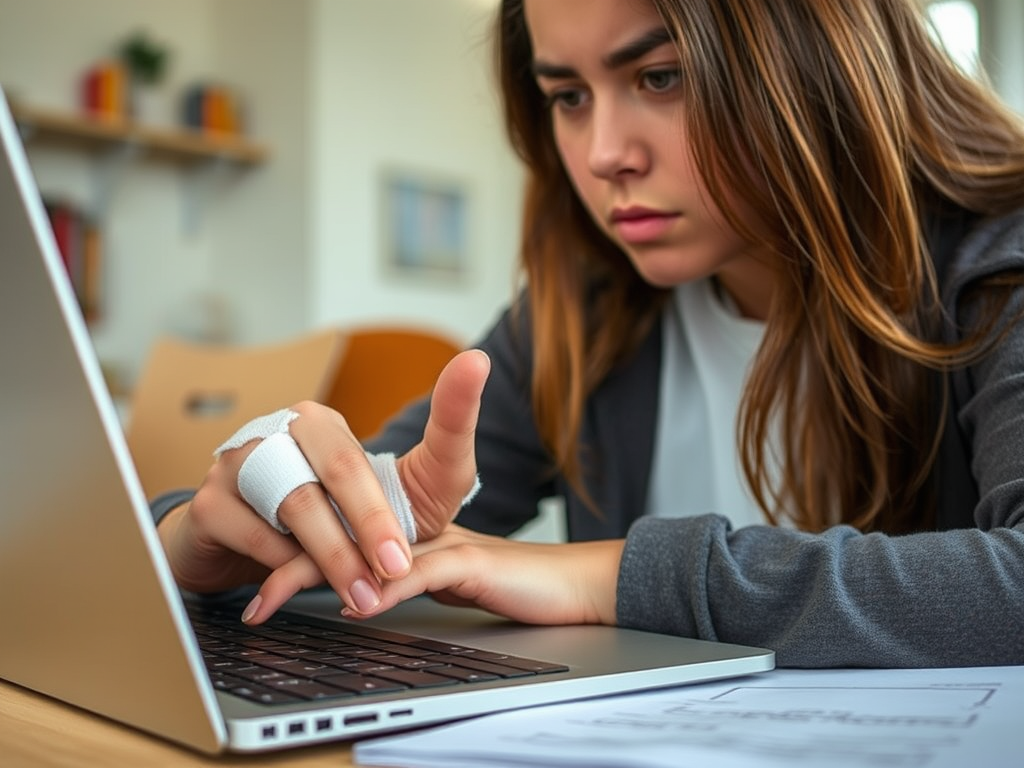
Who would’ve imagined that settling in on Christmas Day to watch White Christmas would end with my first broken bone at 51, hours in the ER, and learning that an essential 11% would be missing from my life for six to eight weeks? Not me, that’s for sure, and yet that is exactly what happened. Christmas Day brought me a gift in the form of a left hand with a broken middle finger. At first, I thought the gift was panic—panic at the realization that I work and am working on a PhD fully online. That means typing, oh, so much typing—all the typing. How would I do it all in the efficient manner I have molded and honed into what has become my life’s blood that feeds my work completion monster? The short answer was—adaptability. Breaking my finger Christmas Day forced me to be creative and flexible, provided perspective on my challenges and those of students, and gave me pause to recognize how diverse learning approaches require an adaptability many of us don’t think about daily.
Before anything else, I feel compelled to say that I hate change. Let me say that again: I. Hate. Change. Even when change makes things better, I fight it with every fiber of my being. As winter break began its descent—landing just eight days after I broke my finger—the stark realization that I would have to embrace change came at me sharply. No, I would resist. My finger could heal in eight days, couldn’t it? I’m an overachiever, after all. I found myself sitting in front of my computer, hands hovering above the keyboard. I was afraid to type. The unforgiving reality of my middle finger held hostage in the clinically cold embrace of the plastic stack splint, making it significantly longer than it should be, would make my limitation real. I took a deep breath. I can do this…
This is precisely where my journey into forced adaptation began. As it turns out, the most common letter when typing, at a whopping 11%, is the letter E (Specktor, 2024). Guess which finger types the letter E? The serious hit my typing speed would be taking was a dealbreaker. I knew that I would have to get over myself and find a way to get that 11% back.
This uncomfortable process started with me answering emails on my phone using voice-to-text. There was no way I’d be able to do all my work on my phone, so I began pontificating about what else I could do. The overthinker in me developed an overly complicated scenario involving research to unearth technology requiring weeks of training. Thankfully, a simple question brought me out of my broken finger despair spiral. From the couch in my office, my husband, typing on his Android phone without looking up, asked, “Doesn’t Mac have something built in already?” “Something?!” I was too exasperated to respond any other way. “You know, for dicta…one second.” After a few moments that felt like hours, he nonchalantly rattled off the steps to find and turn on the already installed dictation software on my Mac (Figure 1). The swipe of a button changed my world forever.
Figure 1
Mac Dictation software, System Preferences, Keyboard Screenshot
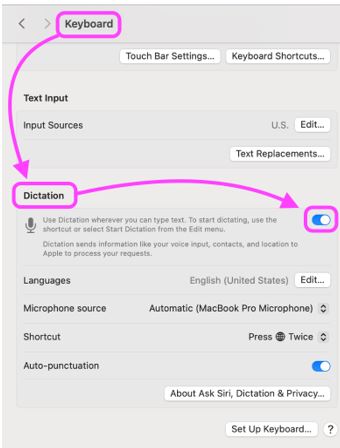
Note. Demonstration of how to find and turn on Dictation on a Mac computer.
As I adapted to saying things rather than typing them, the next step was finding a process to rework my content for my intended audience. When I speak, I innately seek to engage through humor and approachable diction. (I’ll use this opportunity to fill you in on a little secret: I’m using dictation now to write the first draft of this blog. I know—fracturing the fourth wall is a rule that shouldn’t be broken in writing. However, I’m breaking that wall to demonstrate how I sound without actively editing the output of my dictation. See, I’ve gotten much better at speak-writing.)
This is where AI comes in. I also had to get over my fear of AI—to use it and learn how to teach it (well-written AI prompts matter!). Because I am an introvert who processes everything mentally, I had to level up my improvisation skills. In addition to the 11%, I lost the mental pause that thinking paired with typing provided. So, I adapted to using AI as a conduit by dumping my dictation into it and asking it what it would change and why—not having it revise for me. That taught me how to translate my own writing and learn a different way of completing my work based on how my brain is wired.
While this journey began with a ridiculous accident, it gave me unexpected perspective on what students go through when life throws curveballs. I began thinking about how students deal with injuries that affect their ability and motivation, and the workflow process itself and how important learning to build resiliency for success and mental well-being is (Borazon & Chuang, 2023). My journey put diversity in learning approaches and needs front and center. Thinking about how I am wired made me wonder about how important it is for students, with disabilities and otherwise, to have alternative technological approaches and support systems.
Four months later, though I’ve returned to typing, I haven’t let go of the processes and technologies that I white-knuckled through to find. The biggest takeaway is that dictation can be very helpful in unexpected ways. It’s now standard practice for me to use dictation to respond to all student introductory posts during the first week, for example. Because that’s such an important opportunity to create community and set the stage for support, I found that dictation does that best. I dictate every single response, harnessing the benefits of how I speak while being more efficient.
In my quest to respond to every student, I never imagined that dictating would be faster than typing while also working to establish an “online persona” that goes beyond my typed words (Dolan et al., 2022). I’ve also maintained these broken-finger tactics in my professional development, using dictation and AI for brainstorming and keeping on task when overly excited about a project. And because I am currently tangled up (pleasantly) within learning about and applying user experience (UX) and universal design (UDL), I’ve started researching how my Christmas Day ordeal can manifest alternative approaches and opportunities for all students.
It’s strange to say—and yes, I’m still dictating—but I am grateful for the unexpected Christmas gift I received. Knowing how much I loathe change, if I had not broken my finger, I would not have this new skill set and perspective. I feel much like Ebenezer Scrooge at the end of A Christmas Carol, running around in his nightshirt with an energized, positive new perspective, sharing all that I have learned from my journey with those willing to listen, or at least polite enough to humor me, how I got my 11% back and then some.
References
Borazon, E. Q., & Chuang, H-H. (2023, May). Resilience in educational system: A systematic review and directions for future research. International Journal of Educational Development, 99. https://doi.org/10.1016/j.ijedudev.2023.102761
Dolan, J., Kain, K., Reilly, J., & Bansal, G. (2022). How do you build community and foster engagement in online courses? New Directions for Teaching and Learning, 2022(170), 89–100. https://doi.org/10.1002/tl.20510
Specktor, B. (2024, June 23). Can you guess the most common letters in the English language? Reader’s Digest. https://www.rd.com/article/common-letters-english-language/


 The WACademic
Leave a comment