
How Curated Content Assists Student Success

By Sara Wink
Teachers must be prepared to meet students where they are, but they cannot always meet them when they are available. Resource hubs like Wakelet allow educators to provide a curated hub of resources to help students with the challenges they meet throughout the course. Such 24/7 assistance ensures students always have access to the tools they need to achieve academic success.
The work/life balance is an elusive one. Stephanie Hampton, an educator and blogger, discussed this struggle back in 2022: “I knew that teaching was something I would struggle with in terms of navigating the workload of the profession because I have never had any sort of boundary. Teaching was and has been life” (Section 2).
That was me, too. Raised by a teacher and a preacher, the concept of a 9-5 job has always seemed like an other-worldly concept. I work at 4am, 9pm, and whatever hours in between that parenthood allows–just like our students. After all, these are working adults trying to complete their academic journeys when their lives allow. So, when they need support, they NEED SUPPORT.
But educators can’t be present 24/7. We deserve that ability to close our virtual office doors and leave the e-campus to focus on our own lives and loved ones:
…the potential teaching activities in the online classroom may be unlimited but an instructor’s teaching time is not…. It becomes fundamental that online instructors are able to prioritize the limited time they have to devote to instructional strategies that have the most significant impact on student learning. (Steele et al., 2023, p.1)
So how can we provide that 24/7 support without being online 24/7?
One solution that has worked for me and may work for you is a Wakelet.
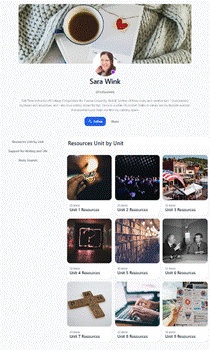
Fig. 1: Screenshot of top of @ProfSaraWink Wakelet Homepage. https://wakelet.com/@ProfSaraWink
I first came across Wakelet when a colleague in Purdue Global’s English and Rhetoric department shared her own Wakelet in a best practices faculty meeting many moons ago. I loved the idea of curated content for education. I could gather university resources, images, videos, web articles, and podcasts all into a single hub of resources for my students! Why not? And I could share the Wakelet link as often as I wish: in my email signature, in my Virtual Office, in weekly emails, and more. No matter where students turn, they wouldhave resources to help them with that particular week’s tasks.
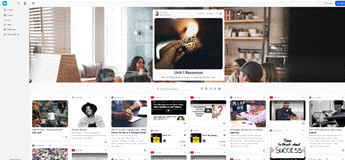
Fig. 2: Screenshot of Unit 1 page on @ProfSaraWink Wakelet. https://wakelet.com/wake/GC_T7BE1JzFI3nzujEGyR
For a content creator, Wakelet itself is a very accessible program—and this is coming from a self-professed Luddite. A basic Wakelet layout involves a border image, a header image, and then the collection title and description. Under that, you can simply add URLs, documents, and images, which will upload without issue most of the time. For the occasional problem link, you can manually edit the entry to type in the title and share a description. If a student clicks on any of those links, a new tab automatically opens for that link. When it comes to header and border images, Wakelet connects you automatically to some public domain sites like Unsplash.
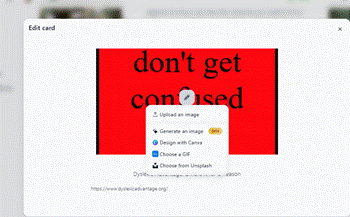
Fig. 3: Screenshot of image editor on Special and Basic Needs Support page on @ProfSaraWink Wakelet. https://wakelet.com/wake/EGZ5pKKDNxqQnK03OpU-Y
Such a hub provides the ability to share not only aids to help students review course material, but supplemental items, too, and such multimodal resources can make a world of difference in empowering student writers (Gray, 2024). After all, my course concentrates on research and persuasive communication; we don’t dwell long on foundation skills like punctuation or sentence structure. Now students could still get answers about those whacky apostrophes even when the Writing Center is closed.
Topic selection, too, is a dilemma for students. My class centers around building research arguments that solve a problem with a local solution. Where should a student begin? Artificial intelligence products like ChatGPT and Google’s Gemini may have some answers, but they are generic at best and grossly misinformed at worst. Plenty of educators have seen vague lines like this: “local governments and community leaders should create programs for change…” Unless a student already has their own vision, it can be very difficult for students to visualize what AI means, and that lack of clarity propounds in the research struggles, drafting woes, and so on. That’s why I have a Wakelet collection dedicated to sharing news articles reporting on community issues as well as solutions achieved at the local level. Now, they can see specific examples of anti-bullying programs, food drives, foster groups, and housing programs.
Plus, I created a podcast to provide some extra review of concepts in my course. To make the podcast more accessible, I made it a collection in my Wakelet. Why make students go to Spotify for one thing, then YouTube, then the Writing Center, then X, Y, and Z when I can just bring all those resources together into a single hub?
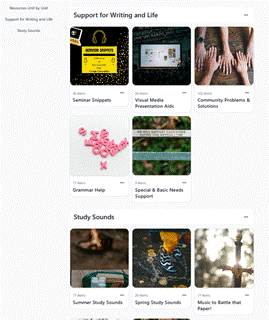
Fig. 4: Screenshot of bottom of @ProfSaraWink Wakelet Homepage. https://wakelet.com/@ProfSaraWink
I should highlight here that organization is key. I have well over a hundred articles for topic inspiration alone. There’s no way I would mingle those articles with other writing resources. To make sure I don’t overwhelm students, I break up my collections of resources unit by unit. All my research tips, for instance, are organized into the units dedicated to research strategies, while the unit dedicated to thesis writing has all the help for thesis creation. For special course materials like topic ideas, I have a separate collection that I also link inside the third unit’s collection, where topics are decided.
Wakelet needn’t be for academics alone. Collections can be created to support our students’ basic needs and mental health by providing links and pages to university resources. It’s also a fine place to provide encouragement, support, and perhaps a bit of peace. When my kids were tiny and bickering over Transformers and Tinkerbell, I often needed to put on music to work. It struck me that to help our students find their own calming space, why not share the nature sounds and music that helped me?
For this is my overall purpose with using Wakelet: to provide the help students need when they need it. Our students use whatever time they can to conquer their academic journeys. That may be at 2:00 AM while others sleep, while on break at work, or while children are at practice. Educators cannot be present for all those moments, nor should we have to be. The digital learning environment has already challenged many of the physical boundaries we once understood with classrooms and campuses (Erstad & Silseth, 2023). Establishing a resource hub with a platform like Wakelet gives educators the chance to provide accessible, specialized assistance so that even if our Virtual Office is closed, students have the guidance and support to press on.
References
Erstad, O., & Silseth, K. (2023). Rethinking the boundaries of learning in a digital age. Learning, Media and Technology, 48(4), 557-565. https://doi.org/10.1080/17439884.2023.2260977
Gray, C. (2024, June 11). Podcasting in education: what are the benefits? The Podcast Host. https://www.thepodcasthost.com/niche-case-study/podcasting-in-education.
Hampton, S. (2022). Redefine work boundaries as a classroom teacher. Writing Mindset. https://www.writingmindset.org/blog/boundaries-classroom-teacher
Steele, J. P., Dyer, T. D., & Mandernach, B. J. (2023). You can’t have it all: faculty and student priorities in the online classroom. International Journal for the Scholarship of Teaching and Learning, 17(1). https://doi.org/10.20429/ijsotl.2023.17108
Wink, S. (2025). Sara Wink. https://wakelet.com/@ProfSaraWink


 The WACademic
Leave a comment