
Creative Writing in the Live Session

By Jonathan Cardew
This article explores the integration of creative writing activities within seminars to promote engagement and exploration. The author demonstrates how low-stakes writing prompts can energize any seminar, fostering a more nuanced approach to creative and critical thinking. Examples of content-specific writing exercises and reflective free-writes are provided with an emphasis on spontaneity, discovery, and freedom of expression.
In my early days of teaching, I often felt an obligation to cover everything in my lectures and seminars. I was positively swimming in concepts and theories, and I needed to pour them all into the willing (perhaps unwitting) cups of my students’ minds. Every line, every minutia of instruction needed imparting; every possible best practice needed dissecting and analyzing. I used lots (and lots…and lots!) of handouts, PowerPoints, whiteboards, and blackboards. I wanted my students to succeed. I needed to squeeze every last second out of the seminar.
I soon learned my mistake: Less, indeed, is more.
Or rather: A focus on skills and engagement is time better spent.
So, what do we do with (teaching) time? The Greek philosopher Theophrastus argues that time “is the most valuable thing a man can spend” and the novelist Alice Walker contends that “time moves slowly but passes quickly” (Traqq, 2024, para. 13). As an English and Composition teacher, I cover many learning outcomes and competencies for my students to master; I want them to demonstrate how to “apply reading skills to determine the elements of effective writing” (Purdue Global, CM107: College Writing I Syllabus, CM107-1 Learning Outcome); I want them to “demonstrate when, how, and why to support [their] writing with appropriate research” (CM107 Syllabus, CM107-4 Learning Outcome).
But, above all else, I want my students to get excited about writing. If my students are critically and creatively engaged with the writing process, they will achieve the most success. And, for me, one of the key ways to achieve this overriding goal has been through the inclusion of short bursts of creative writing exercises in seminar.
What do I mean by a “short burst of creative writing”? This could be anything from a three-minute timed writing warm-up at the beginning of a seminar to a more structured concept-specific writing task within the hour. These creative writing activities do not need to take place in the writing classroom; any teacher in any discipline can employ these approaches.
Because you (reader of this blog) are now (unwittingly) my student for a few more precious minutes, I would like to invite you to try the following exercises yourself (and possibly consider adapting and incorporating these into your own seminar teaching time).
- The Power of the Prompt
I use low-stakes creative writing activities in the seminar, often at the beginning, as a way to “warm up students” or act as a small respite from the main lecture. They provide students with an opportunity to engage in the writing process, allowing for a free discovery of voice and tone without the restrictive nature of graded assignments (Van Lieu, 2015). Creative prompts also work effectively as precursors to more academic writing because of the enthusiasm they can generate (Friedman, 2023).
The following creative writing prompt preceded an analysis of an article on homelessness.
If you have time, why not try this yourself?
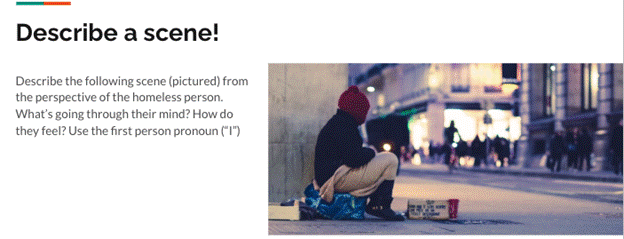
Fig. 1: Screenshot of slide from Unit 2 Seminar (CM107). (Note. Homeless [Photograph], by Ev, 2023, Unsplash. https://unsplash.com/s/photos/homeless. CC BY 2.0.)
- Topic Specific
Sometimes, a concept is better grasped from a new angle. A key skill I teach in first-term college composition is thesis writing–one of the trickier concepts to master.
In an attempt to help students consider their own burgeoning research topics, I take a few minutes out of the Unit 6 Seminar for students to write a haiku loosely based on the subject they are tackling. While I am not teaching students the principles and practice of poetry, my goal with this activity is for students to aim for conciseness of message. By following the structured (and short) form of 5-7-5 syllables, they must get to the heart of their “thesis” in fewer words than they would probably like.
If you have a topic or research project in the brainstorming phase, why not try the following task yourself?

Fig. 1: Screenshot of slide from Unit 6 Seminar (CM107). (Note. Gary Unicorn [Image]. https://www.baschurchprimary.org.uk/may-19th-home-work/)
In a nutshell, creative writing allows for exploration and examination free from the rigidity of more academic and professional styles of writing. While some of my students find these activities challenging (they feel they cannot “produce” enough within the allotted time frame or they feel they are not “good enough” writers), most express interest and excitement in doing these short exercises.
One student asked (after attempting the haiku task), what is the point of poetry? This, to my surprise and delight, sparked an intense debate on the value of creative writing and the ultimate purpose behind any writer’s goal when setting out on the writing process.
Which, as a teacher of writing, is exactly the spark I want.
References
Darlow, S. (2022). Gary Unicorn [Image]. 19th May Home Work. Baschurch CE (A) Primary School. https://www.baschurchprimary.org.uk/may-19th-home-work/
Ev. (2023). Homeless [Photograph]. Unsplash. https://unsplash.com/s/photos/homeless.
Friedman, S. (2023). Vision and revision: The whys and hows of employing creative writing pedagogy in the college classroom. The CEA Forum, 2, 59-71. https://ceaforum-ojs-ttu.tdl.org/ceaforum/article/view/7186
Traqq. (2024, December 10). 5 best time quotes. https://traqq.com/blog/top-quotes-about-time/
Van Lieu, S. (2015). Writing prompts: Generating engagement, critical thinking, and discovery. Journal of Instructional Research, 4, 148-156. https://files.eric.ed.gov/fulltext/EJ1127741.pdf.

 The WACademic
Leave a comment