
By Dr. James McAdams
Faculty now have permission to create extracurricular discussion modules as an option to boost student engagement. Examples might include modules for students in recovery, students in the military, cute pet pictures, baby advice, and so forth. Exploration and experimentation with this integration have resulted in increased audiovisual participation and a more unified classroom community.
On July 7, 2023, a date memorialized with a smiley face on my trusty Franklin Planner, a modification to Brightspace permissions empowered faculty to add optional, additional discussion modules in order to personalize the classroom community or share extracurricular materials. I grasped this opportunity to support students at the level of their individual experiences by adding targeted, non-academic discussion modules to Brightspace. Suddenly, students had a place to express themselves and share their interests outside the mandated and sometimes intimidating academic discussion boards.
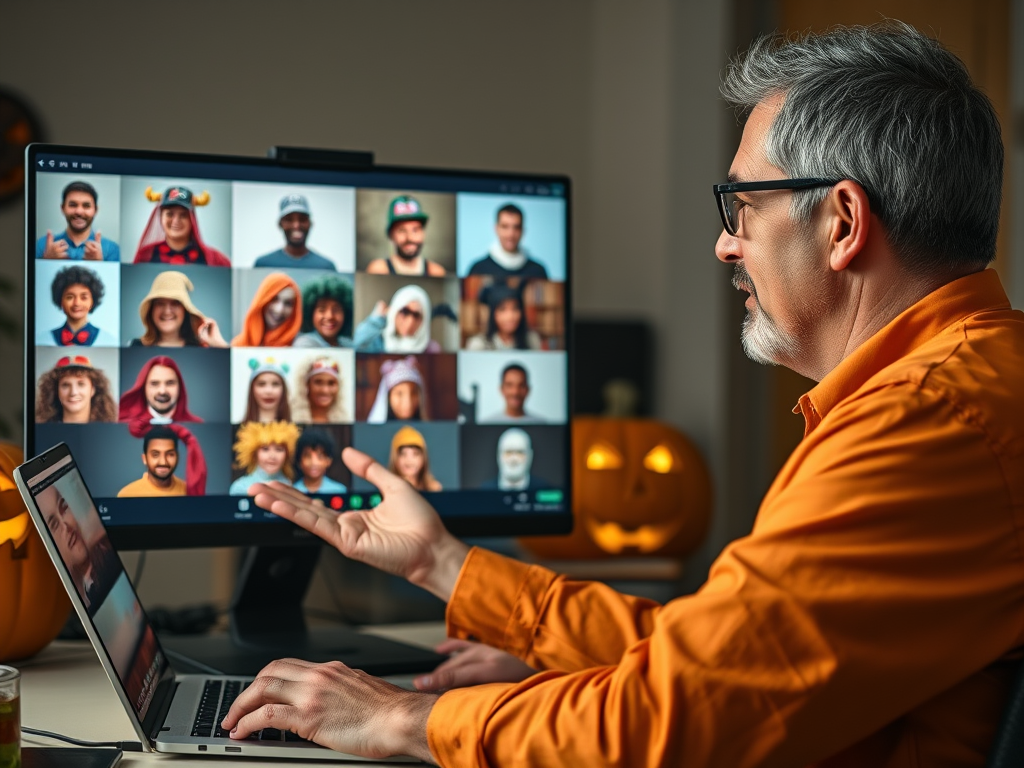
As I write this first of five drafts on Halloween night (while watching Halloween, of course), I am reminded of the first extracurricular discussion module I ever created. Simply called “Halloween Pictures,” the module invited students to “share your best costumes, your cute kids, your Halloween treats, house decorations, or anything else that shows us who you are outside of academia!!” Since I hadn’t prepared them for this in the initial class announcements or previous seminars, I didn’t expect much, but after sending the link in an email blast, I was soon elated to see more than ten students begin to engage, comment, and post pictures.
The seminar following this was the best of the term. Almost a third of the class was on camera, more were talking on their mics, and the chat scroll was erupting. The students actually addressed each other by name! Most of the comments related back to those Halloween pictures and conversations but moved beyond this to other areas, such as sports, TV, movies, video games, and pets.
To build on this opportunity, I created more modules: one for students in recovery, one for students in the military, one for pets. While none were as successful as the Halloween forum – because what’s more popular than Halloween? – I saw a steady increase in camera and microphone engagement in seminars. By the end of the term, on average, at least ten students were on camera, plus a few others who couldn’t be on camera used their microphones. This was the most success I’d had creating an audio-visual community while at Purdue, and to be honest, remains my most successful (as an A-tracker, I sadly missed Halloween with my students this week).
The boards are just a tool, an example. The larger point is that neuroscience teaches us that seeing people makes them more real to us, and hence we develop a predilection to like them and to talk to them. As Schwartz et al. (2024) explain, “our findings suggest that while technology-based communication allows humans to synchronize from afar, face-to-face interactions remain the superior mode of communication for interpersonal connection” (para 1). This study is solely concerned with “IRL” face-to-face communication, and I couldn’t find any existing data specifically on the kind of video conferencing we do in Zoom. However, as professors, I think we all “know” a few things instinctively: 1) students on camera/microphone tend to succeed; 2) once one student gets on camera/microphone, others follow; and 3) the more students on camera/microphone, the better the sense of community in seminar, and 4) an improved sense of community supports student retention and success.
How do we encourage students to be on camera and microphone? Mentioning “inter-brain synchrony” is unlikely to help! A better strategy may be to gently remind them that their jobs in the future will presuppose psychological, technological, and practical abilities with platforms such as Zoom, Google Meet, Facetime, and Microsoft Teams. Psychologically, they need to overcome social anxiety and introversion; technologically, they need to learn to activate all those tools put in place to improve the user experience (UX): skills like “raising hands” (and lowering hands, which I’m still working on!), sharing screens, uploading files to chat, recording, transcribing, and so on; finally, practically they need to learn to either use virtual backgrounds to enhance a professional appearance or locate and decorate an office space that defines their job and shows they take it seriously.
In my own experience, the best way to encourage students to experiment with going on camera during seminars at Purdue University Global is that it is a “safe space.” Nobody will judge you if you have a baby in your lap; nobody will judge you if your cat jumps on the keyboard (in fact, that might be the best moment of the class); nobody will judge you if your background is a kitchen with a sink full of dirty dishes. By making this a safe space, we can improve seminars, improve community belonging, improve grades, improve student retention, and prepare students for more successful careers … And if, while we’re at it, we can improve “inter-brain synchrony,” who on Earth can protest that? One pixel, one picture, one face, two faces, three faces, a friendship, a clique, a community: it all starts with Halloween. As we’re now well into November, I encourage you to create that Halloween module before your candy goes stale.
Reference
Schwartz, L., Levy, J., Hayut, O., Netzer, O., Endevelt-Shapira, Y., & Feldman, R. (2024). Generation WhatsApp: inter-brain synchrony during face-to-face and texting communication. Scientific Reports, 14(1) https://doi.org/10.1038/s41598-024-52587-2


 The WACademic
Leave a comment